

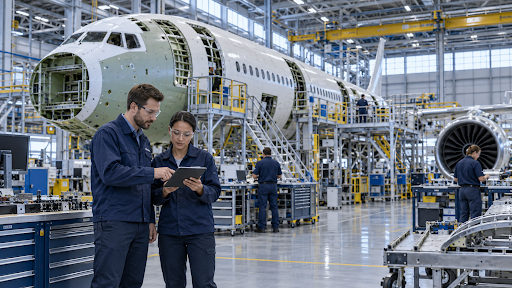
Aerospace and defense manufacturers operate in one of the world’s most demanding production environments. Strict quality requirements, complex products, regulated processes, fragile supply networks, and increasing production targets create constant operational pressure. Addressing today’s defense and space manufacturing industry challenges requires more than a strong strategy. Manufacturers need disciplined execution that connects production, suppliers, quality, maintenance, engineering, and leadership.
Why Aerospace Manufacturing Is So text
Aerospace programs depend on thousands of specialized components produced across multi-tier supplier networks. A delay involving a single critical part can interrupt assembly, increase work in progress, and place an entire delivery schedule at risk.
At the same time, manufacturers must maintain tight tolerances, complete detailed documentation, and comply with rigorous quality and safety standards. These requirements cannot be compromised when organizations are asked to increase production. As output targets rise, weaknesses in planning, material availability, workforce capability, and process stability become more visible.
Among the most serious aviation and aerospace component manufacturing industry challenges is the difficulty of scaling production without increasing defects, delays, inventory, and operating costs.
Unstable Production Ramp-Ups
Production ramp-ups often appear achievable in a strategic plan but become difficult on the shop floor. Bottlenecks may move between work centers, output can vary across shifts, and teams may spend more time reacting to problems than improving performance.
Simply adding employees or equipment does not guarantee higher throughput. Manufacturers should first identify operational constraints, stabilize workflows, standardize critical processes, and establish a daily management system. Real-time performance tracking and clear accountability allow teams to respond to issues before they affect program milestones.
Supplier Performance and Material Shortages
Aerospace manufacturing capacity depends heavily on supplier capacity. Long lead times, inaccurate planning signals, limited supplier visibility, and inconsistent delivery performance can create frequent shortages.
Some manufacturers respond by increasing inventory, but this ties up working capital without necessarily protecting production. A more sustainable approach is to connect supplier schedules with actual manufacturing demand. Supplier capacity assessments, constraint visibility, accurate planning data, and structured performance reviews help organizations identify risks before they disrupt production.
Quality Problems That Interrupt Flow
Quality is essential in aerospace and defense, but reactive quality management can slow production significantly. Defects create rework, inspection queues, additional costs, and delivery delays.
Rather than depending primarily on final inspection, manufacturers should build quality controls directly into production processes. Standard work, root-cause analysis, mistake-proofing, and performance data can help prevent recurring defects. When processes become more stable, manufacturers can improve first-pass yield while maintaining compliance and product integrity.
Planning and Scheduling Misalignment
Production plans are often created using assumptions that do not reflect real shop-floor conditions. Equipment limitations, labor availability, engineering changes, supplier delays, and quality holds can quickly make a schedule unrealistic.
Constraint-based planning helps manufacturers build schedules around actual operating conditions. Production, supply chain, engineering, and maintenance teams should work from a shared plan with clearly defined priorities. When circumstances change, decisions can be made using current information instead of delayed reports or disconnected spreadsheets.
Using Digital Tools and AI Effectively
Digital platforms and artificial intelligence can improve demand forecasting, production scheduling, supplier planning, predictive maintenance, and quality inspection. However, technology cannot correct weak operational processes on its own.
Before scaling a digital solution, manufacturers should establish reliable data, process ownership, defined workflows, and clear performance measures. Technology creates the most value when it supports the daily decisions made by managers, planners, engineers, and frontline teams.
Building Sustainable Operational Performance
Aerospace and defense organizations can overcome manufacturing challenges by treating the operation as one connected system. Production, quality, maintenance, supply chain, and leadership must be aligned around shared objectives and consistent management routines.
Implementation Engineers helps aerospace and defense manufacturers turn operational strategies into measurable results through hands-on implementation. By stabilizing production, strengthening supplier performance, improving planning, and embedding sustainable operating systems, manufacturers can increase throughput, protect quality, reduce costs, and achieve more predictable delivery performance.