
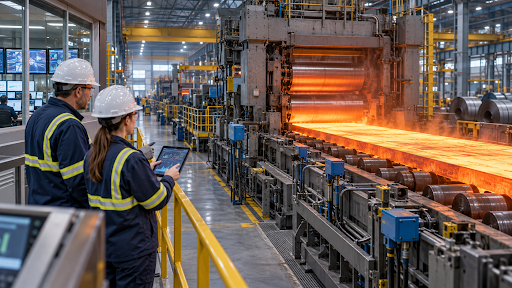
Metals manufacturers operate in demanding environments where equipment downtime, process variation, energy consumption, and material waste can significantly affect profitability. The adoption of metalworking industry 4.0 capabilities allows steel, aluminum, and other metals producers to connect machinery, operational data, maintenance systems, and employees to improve performance across the plant.
Industry 4.0 is not simply about purchasing new software or installing more sensors. Its real value comes from using digital technology to solve specific operational problems and support better day-to-day decisions.
Improving Equipment Reliability
Casting equipment, rolling mills, furnaces, finishing lines, and material-handling systems are critical to metals production. When one important asset fails unexpectedly, it can interrupt the entire process and create substantial production losses.
Connected sensors and condition-monitoring systems can continuously track vibration, temperature, pressure, and other indicators of equipment health. This data can help maintenance teams recognize developing problems before they result in failure.
Predictive maintenance tools can also support better work prioritization. Instead of relying only on fixed maintenance intervals or reacting after equipment stops, teams can plan interventions according to actual asset conditions. This can reduce unplanned downtime, improve mill availability, and extend equipment life.
Creating Real-Time Operational Visibility
Many metals plants still depend on paper records, spreadsheets, and delayed production reports. When information arrives hours or days after an issue occurs, managers have limited ability to correct performance during the shift.
Digital production systems provide greater visibility into output, downtime, speed losses, quality, and overall equipment effectiveness. Operators and supervisors can identify performance gaps sooner and take action while production is still running.
However, dashboards alone do not improve results. Plants also need clear daily management routines, defined ownership, and escalation processes. Real-time data becomes valuable when teams understand how to interpret it and use it consistently.
Increasing Yield and Reducing Scrap
Small variations in temperature, equipment settings, material composition, or process timing can affect product quality. When these variations are not identified quickly, manufacturers may experience increased scrap, rework, downgraded products, and higher operating costs.
Industry 4.0 systems can collect and analyze production data across casting, rolling, processing, and finishing operations. Advanced analytics can help teams recognize patterns between process conditions and quality outcomes.
This information supports root-cause analysis and allows manufacturers to strengthen process controls. More stable production can improve yield, reduce waste, and increase the amount of saleable product created from the same raw materials.
Managing Energy and Operating Costs
Metals manufacturing is highly energy intensive. Furnaces, mills, compressed-air systems, cooling equipment, and other assets can consume significant amounts of energy, especially when processes are unstable or equipment is not performing efficiently.
Digital monitoring enables manufacturers to compare energy consumption with production output and operating conditions. This makes it easier to locate abnormal usage, inefficient assets, and opportunities for process optimization.
Artificial intelligence and analytics can further support decisions involving production sequences, operating parameters, and asset performance. The objective should be measurable reductions in cost per unit rather than technology adoption without a clear operational purpose.
Connecting Technology with the Workforce
The success of Industry 4.0 depends on the people who use it. Operators, maintenance technicians, engineers, and supervisors need appropriate training and must understand how digital tools improve their work.
Connected worker applications, digital work instructions, and mobile access to operational information can make knowledge easier to share. These capabilities are particularly useful when experienced employees retire and manufacturers need to transfer critical process knowledge to newer team members.
Turning Digital Strategy into Measurable Results
A successful transformation begins by identifying the operational problems that create the greatest business impact. Manufacturers should then establish reliable data, standardize processes, define ownership, and select technologies that support those priorities.
Implementation Engineers works directly with metals manufacturers to improve mill reliability, production stability, yield, maintenance execution, and operational visibility. By combining Industry 4.0 tools with hands-on implementation and disciplined operating systems, metals producers can reduce downtime, control costs, and sustain stronger performance across their operations.